Physical Address
304 North Cardinal St.
Dorchester Center, MA 02124
Physical Address
304 North Cardinal St.
Dorchester Center, MA 02124
Last updated: July 18, 2026
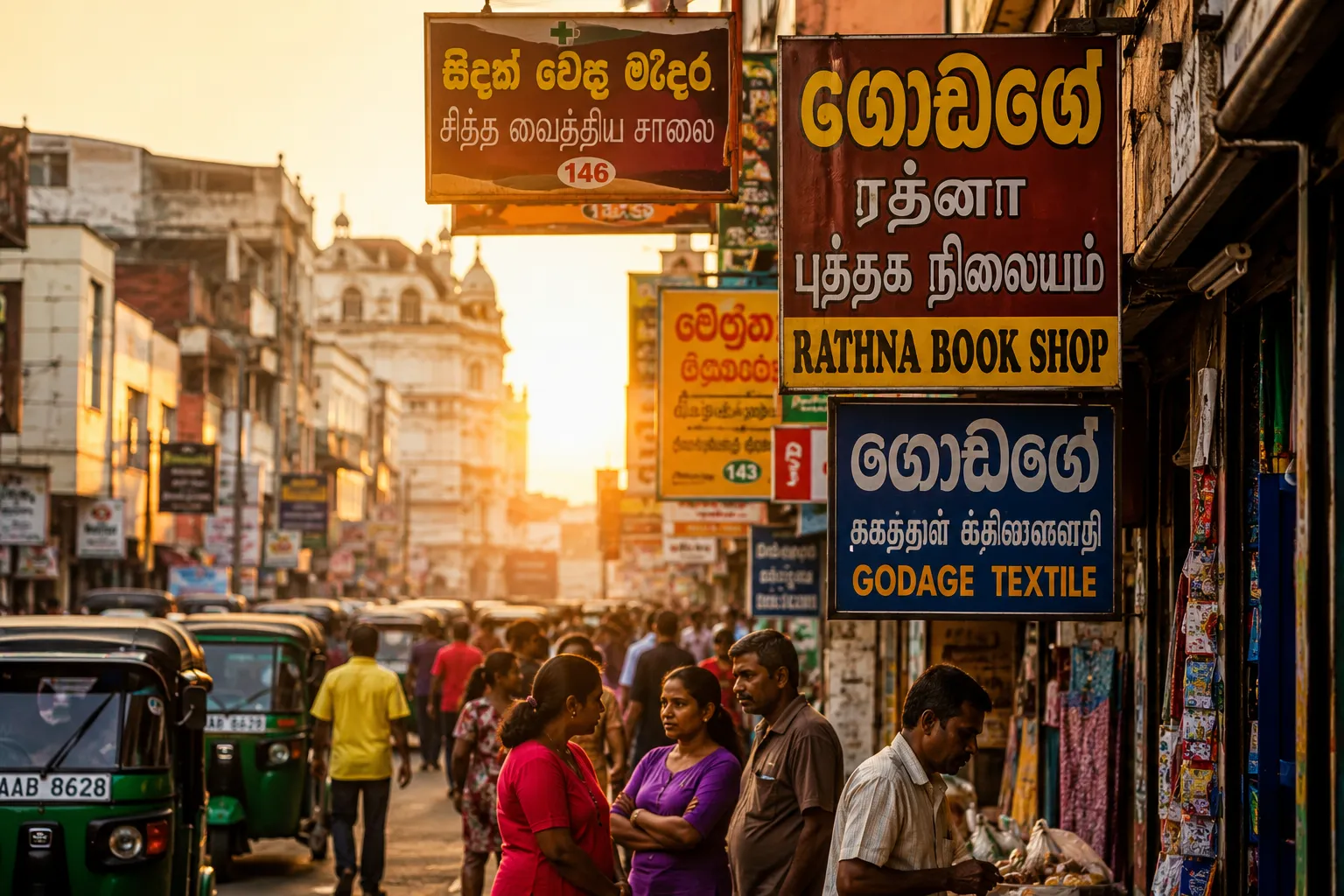
Learning basic Sinhala and Tamil phrases transforms your Sri Lanka experience from tourist observation to genuine cultural connection. These essential phrases help you navigate daily interactions, show respect for local culture, and often lead to warmer welcomes and better service throughout your journey.
• Sinhala is spoken by about 75% of Sri Lankans, while Tamil is used by roughly 18% of the population • Essential greetings like “Ayubowan” (Sinhala hello) and “Vanakkam” (Tamil hello) immediately show cultural respect • Basic phrases for food ordering, directions, and emergencies are most practical for travelers • Pronunciation apps and phonetic guides help you sound more natural when speaking • English is widely understood in tourist areas, but local phrases unlock authentic experiences • Learning 10-15 key phrases in each language covers most travel situations • Sinhala uses unique script characters, while Tamil script differs significantly from both • Free online resources provide audio pronunciation guides for proper accent development
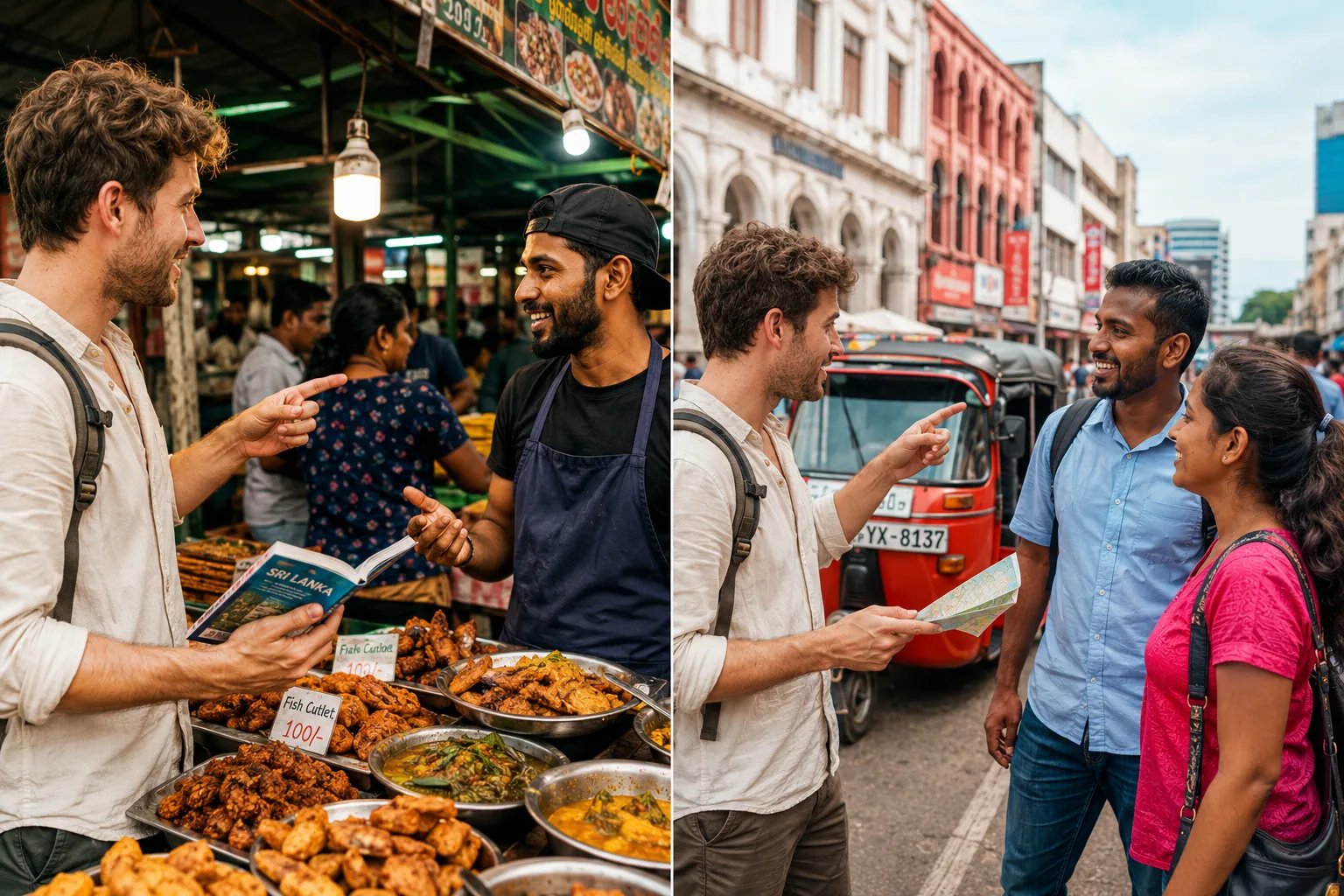
The most practical Sinhala phrases focus on greetings, basic needs, and polite conversation starters that work in markets, restaurants, and everyday interactions.
Essential Greetings and Politeness: • Ayubowan (ah-yu-bo-wan) – Hello/Welcome • Sthūthiyi (stoo-ti-yi) – Thank you • Karunākara (ka-ru-na-ka-ra) – Please • Ow (oh) – Yes • Næhæ (nay-hay) – No • Samāvenna (sa-ma-ven-na) – Goodbye
Basic Conversation Starters: • Kohomada? (ko-ho-ma-da) – How are you? • Mage nama… (ma-ge na-ma) – My name is… • Oyāge nama mokakda? (o-ya-ge na-ma mo-kak-da) – What’s your name? • Mama therenne nähä (ma-ma the-ren-ne nay-hay) – I don’t understand
These phrases work across all regions of Sri Lanka and show immediate respect for Sinhala culture [1]. Most locals appreciate any attempt to use their language, even with imperfect pronunciation.
Tamil greetings in Sri Lanka follow traditional South Indian patterns but with some local variations that reflect the island’s unique cultural blend.
Core Tamil Greetings: • Vanakkam (va-nak-kam) – Hello (universal greeting) • Nandri (nan-dri) – Thank you • Mannikavum (man-ni-ka-vum) – Please/Excuse me • Aam (ahm) – Yes • Illai (il-lai) – No
Time-Specific Greetings: • Kaalai vanakkam (ka-lai va-nak-kam) – Good morning • Maalai vanakkam (ma-lai va-nak-kam) – Good evening • Iravu vanakkam (i-ra-vu va-nak-kam) – Good night
Tamil speakers in Sri Lanka, particularly in the Northern and Eastern provinces, use these phrases daily. The pronunciation tends to be slightly softer than in Tamil Nadu, with some words borrowed from Sinhala in mixed communities.
Digital language tools provide audio pronunciation guides and structured phrase practice that traditional phrasebooks can’t match.
Top-Rated Language Apps: • Ling App – Offers comprehensive Sinhala phrase collections with audio pronunciation and cultural context [9] • Duolingo – Limited Sinhala content but excellent for Tamil basics • Google Translate – Real-time voice translation for both languages, though accuracy varies • Memrise – Community-created Sinhala and Tamil phrase decks with spaced repetition
Specialized Sri Lankan Resources: • Omniglot – Detailed phrase guides with multiple pronunciation variants [3] • Wikivoyage Phrasebooks – Travel-focused phrases organized by situation [10]
Choose apps that include audio pronunciation, as both Sinhala and Tamil have sounds that don’t exist in English. The Ling App specifically caters to travelers with situation-based phrase groupings rather than academic grammar lessons.
Food and navigation phrases solve the most frequent communication challenges travelers face in Sri Lanka’s restaurants and streets.
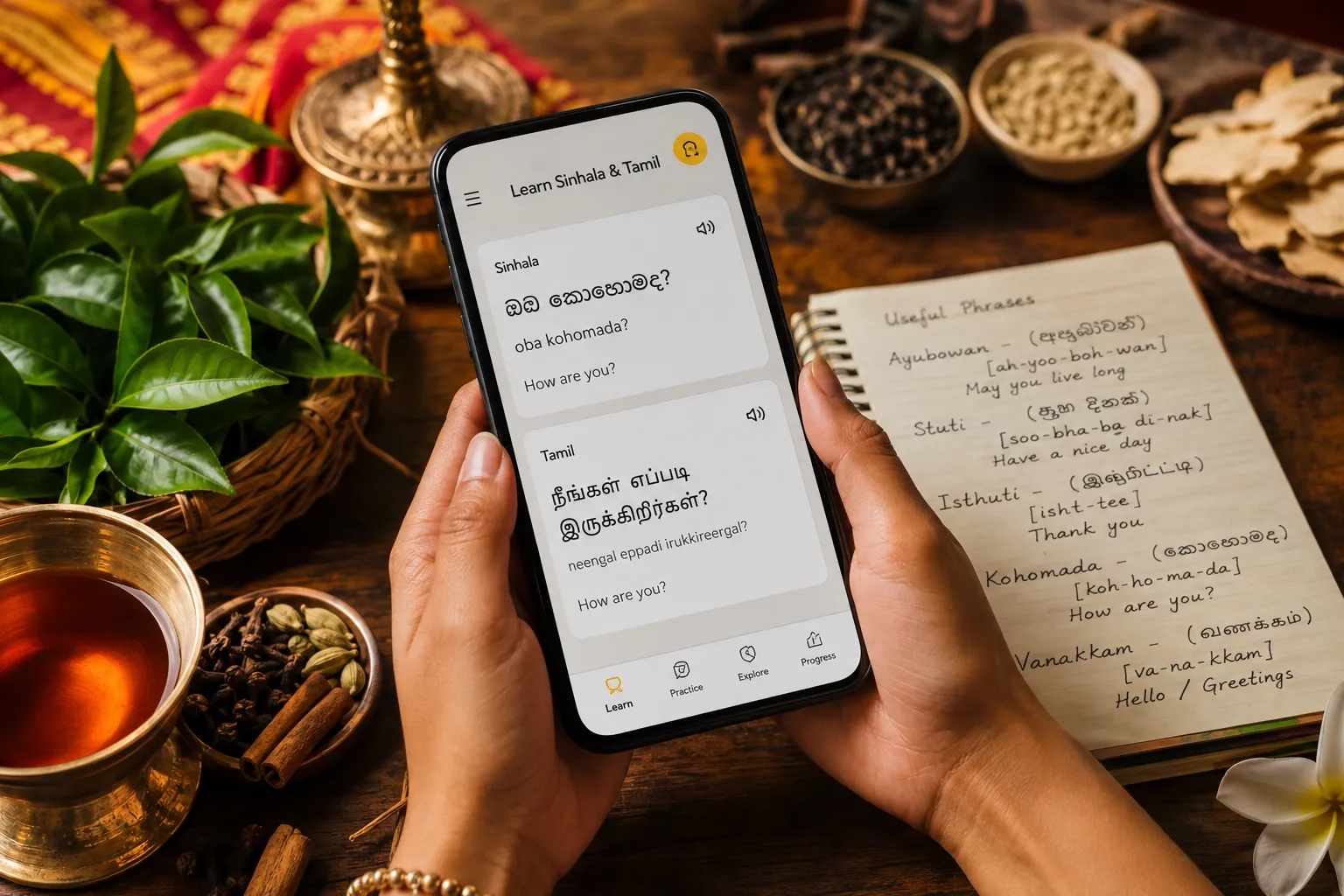
Restaurant and Food Phrases: • Mata… onē (ma-ta… o-nay) – I want… • Mata vathura onē (ma-ta va-thu-ra o-nay) – I want water • Mē kiyadā? (may ki-ya-da) – How much is this? • Kāma nähä (ka-ma nay-hay) – Not spicy (crucial for sensitive stomachs) • Bath ekak (bat e-kak) – One rice (portion)
Direction and Location Phrases: • …kohēda? (ko-hay-da) – Where is…? • Toilet eka kohēda? (toilet e-ka ko-hay-da) – Where is the toilet? • Railway station eka kohēda? – Where is the railway station? • Mama hāragiyāmi (ma-ma ha-ra-gi-ya-mi) – I am lost • Mē paththē yanna (may pat-thay yan-na) – Go this way
These phrases work in most restaurants and shops throughout Sinhala-speaking areas. Restaurant staff often understand basic English, but using Sinhala typically results in more attentive service and sometimes better prices [7].
Tamil pronunciation requires attention to specific sounds and tonal patterns that differ significantly from English phonetic systems.
Key Pronunciation Rules: • Retroflex sounds – Tongue touches the roof of your mouth for ‘t’, ‘d’, ‘n’ sounds • Aspirated consonants – Add slight breath after ‘k’, ‘p’, ‘t’ sounds • Vowel length matters – Short ‘a’ vs. long ‘aa’ changes word meaning • No silent letters – Pronounce every written character
Common Beginner Mistakes: • Pronouncing ‘zh’ sound (ழ) like English ‘l’ instead of the correct retroflex ‘r’ • Missing the distinction between short and long vowels • Adding English stress patterns instead of Tamil rhythm • Dropping final consonants that are clearly pronounced in Tamil
Practice Tips: • Listen to native speakers on YouTube or language apps • Record yourself and compare to audio guides • Focus on one phrase at a time rather than memorizing lists • Practice with Tamil speakers who can correct your pronunciation immediately
Tamil has 12 vowels and 18 consonants, creating combinations that don’t exist in English. The retroflex sounds are particularly important for being understood clearly.
Sinhala and Tamil represent completely different language families with distinct scripts, grammar structures, and cultural contexts within Sri Lanka.
Script and Writing Systems: • Sinhala uses a curved, flowing script derived from ancient Brahmi • Tamil uses an angular script with distinct character shapes • Neither script resembles English letters or sounds • Both read left to right, unlike some other South Asian languages
Grammar and Structure Differences: • Sinhala belongs to the Indo-European language family (related to Hindi, Bengali) • Tamil is Dravidian (related to Telugu, Malayalam, Kannada) • Word order: Both use Subject-Object-Verb structure (different from English) • Verb conjugation: Tamil has more complex tense systems than Sinhala
Geographic and Cultural Context: • Sinhala dominates in central, southern, and western Sri Lanka • Tamil is primary in northern and eastern provinces • Buddhism influences Sinhala vocabulary and expressions • Hinduism and Christianity influence Tamil phrases and cultural references
Understanding these differences helps you choose which language to prioritize based on your travel destinations within Sri Lanka [8].
Tamil phrases become essential when traveling to Jaffna, Trincomalee, Batticaloa, and other Tamil-majority areas where Sinhala may not be widely understood.
Travel and Transportation: • Bus enge? (bus en-gay) – Where is the bus? • Train station enge? (train station en-gay) – Where is the train station? • Evvalavu? (ev-va-la-vu) – How much? • Romba adhigam (rom-ba a-dhi-gam) – Too expensive • Konjam kammiyaga (kon-jam kam-mi-ya-ga) – A little less (for bargaining)
Accommodation and Services: • Room irukka? (room i-ruk-ka) – Is there a room? • Sapadu enge? (sa-pa-du en-gay) – Where is food? • Neer vendum (neer ven-dum) – I need water • Hospital enge? (hospital en-gay) – Where is the hospital?
Cultural Interaction: • Ungal peyar enna? (un-gal pe-yar en-na) – What is your name? • Naan tourist (naan tourist) – I am a tourist • Tamil theriyadu (ta-mil the-ri-ya-du) – I don’t know Tamil • English pesalama? (English pe-sa-la-ma) – Can we speak English?
These phrases work particularly well in Tamil cultural sites, local markets, and family-run guesthouses where English may be limited.
Polite conversation in Sinhala culture emphasizes respect, hierarchy, and genuine interest in others’ well-being, reflected in specific phrase choices and tones.
Respectful Address Forms: • Mahathaya (ma-ha-tha-ya) – Sir (to older men or authority figures) • Mahathmi (ma-ha-th-mi) – Madam (to older women or authority figures) • Aiya (ai-ya) – Elder brother (casual respect to men) • Akka (ak-ka) – Elder sister (casual respect to women)
Polite Conversation Starters: • Suwapathak venna (su-wa-pa-thak ven-na) – Have a safe journey • Bohoma sthūthi (bo-ho-ma stoo-ti) – Thank you very much • Kshama karanna (ksha-ma ka-ran-na) – Please forgive me/Excuse me • Oya kohomada innē? (o-ya ko-ho-ma-da in-nay) – How are you? (formal)
Showing Cultural Respect: • Theruwan saranai (the-ru-wan sa-ra-nai) – May you be blessed by the Triple Gem (Buddhist blessing) • Budu saranai (bu-du sa-ra-nai) – May Buddha bless you • Godak pin (go-dak pin) – Much merit (expressing gratitude for kindness)
Using these respectful forms, especially with older people or in religious contexts, demonstrates cultural awareness that Sri Lankans deeply appreciate [4].
Learning conversational Sinhala for travel purposes typically requires 2-4 weeks of focused daily practice, though fluency takes significantly longer due to the unique script and grammar structure.
Realistic Timeline Expectations: • Week 1-2: Master essential greetings, numbers, and basic needs phrases • Week 3-4: Add food ordering, directions, and simple conversations • Month 2-3: Understand responses and engage in basic back-and-forth exchanges • 6+ months: Read simple signs and handle complex travel situations independently
Factors Affecting Learning Speed: • Previous language experience – Knowing other South Asian languages helps significantly • Daily practice time – 30 minutes daily vs. 2 hours daily makes dramatic differences • Immersion opportunities – Speaking with native speakers accelerates progress • Script learning – Reading Sinhala characters adds months to the timeline
Practical Learning Approach: Focus on spoken phrases first, then tackle the script later if needed. Most travelers succeed with phonetic pronunciation guides without learning to read Sinhala characters [5].
Quality free Tamil learning resources provide structured lessons, audio pronunciation, and cultural context without subscription fees or app purchases.
Comprehensive Online Platforms: • Omniglot Tamil Section – Detailed phrase collections with pronunciation guides • Languages Galore – Organized phrase categories for practical use [5] • I Love Languages – Audio pronunciation with native speaker recordings [6] • YouTube Channels – “Learn Tamil with Kausalya” and “Tamil Virtual Academy” offer structured lessons
Interactive Practice Tools: • Quizlet – User-created Tamil phrase flashcard decks with audio • Anki – Spaced repetition flashcards for long-term retention • Google Translate – Voice practice and instant pronunciation feedback • Tamil Virtual University – Government-sponsored free courses
Cultural Context Resources: • Tamil Heritage Foundation – Cultural background for phrases and expressions • Sri Lankan Tamil websites – Local variations and contemporary usage • Tamil radio stations online – Passive listening for accent and rhythm
Combine multiple resources rather than relying on a single platform. Audio-heavy resources work better than text-only materials for developing natural pronunciation.
Choose Sinhala as your primary language focus since it’s understood by 75% of the population and works throughout most tourist destinations, then add basic Tamil phrases if visiting northern or eastern regions.
Sinhala-First Strategy Works Best Because: • Wider geographic coverage – Useful in Colombo, Kandy, Galle, Nuwara Eliya, and southern beaches • Tourism industry standard – Most hotels, restaurants, and tour guides speak Sinhala • Cultural sites – Buddhist temples and cultural triangle sites primarily use Sinhala • Transportation – Bus and train announcements often in Sinhala first
Add Tamil When Visiting: • Jaffna Peninsula – Tamil is the primary language • Eastern Province – Trincomalee, Batticaloa, Arugam Bay Tamil-speaking areas • Tamil cultural sites – Hindu temples and Tamil heritage locations • Northern beaches – Less touristy areas where English is limited
Practical Learning Sequence:
This approach maximizes your communication ability across the broadest range of travel situations [8].
Sinhala pronunciation errors typically stem from applying English sound patterns to a language with completely different phonetic rules and tonal qualities.
Most Frequent Pronunciation Errors: • Aspirated consonants – Missing the breath release after ‘k’, ‘p’, ‘t’ sounds • Retroflex confusion – Pronouncing tongue-tip sounds like regular ‘t’, ‘d’, ‘n’ • Vowel length ignorance – Not distinguishing between short ‘a’ and long ‘aa’ sounds • Final consonant dropping – Sinhala clearly pronounces word-ending consonants
Script-Related Mistakes: • Character combination errors – Misreading combined characters as separate sounds • Vowel marker confusion – Missing vowel modifications that change pronunciation • Silent letter assumptions – Assuming some characters are silent like in English
Tonal and Rhythm Problems: • English stress patterns – Applying English word stress to Sinhala phrases • Speaking too fast – Rushing through unfamiliar sound combinations • Monotone delivery – Missing Sinhala’s natural melodic patterns
Correction Strategies: • Record native speakers and mimic their exact rhythm and tone • Practice individual sounds before attempting full phrases • Ask Sinhala speakers to correct you immediately rather than being polite • Focus on one phrase until pronunciation is natural before adding new ones
The key is accepting that Sinhala sounds fundamentally different from English and requires retraining your mouth and ear [1].
Emergency phrases in Sinhala can be crucial for getting immediate assistance when English communication fails or in remote areas with limited English speakers.
Critical Emergency Phrases: • Udav karanna! (u-dav ka-ran-na) – Help! • Police kanna! (police kan-na) – Call the police! • Dōsthara kanna! (dose-tha-ra kan-na) – Call a doctor! • Mama ledā! (ma-ma le-da) – I am sick! • Mama hāragiyāmi (ma-ma ha-ra-gi-ya-mi) – I am lost!
Medical Emergency Communication: • Mata vēdanāva (ma-ta vay-da-na-va) – I have pain • Mage… vēdanāva (ma-ge… vay-da-na-va) – My… hurts • Hospitala yanna onē (hos-pi-ta-la yan-na o-nay) – Need to go to hospital • Medicine onē (medicine o-nay) – Need medicine • Mata allergy tiyenava (ma-ta allergy ti-ye-na-va) – I have allergies
Safety and Security: • Mata baya hitēnava (ma-ta ba-ya hi-tay-na-va) – I feel scared • Mē thāna bēhēi (may tha-na bay-hay-i) – This place is dangerous • Police station eka kohēda? (police station e-ka ko-hay-da) – Where is the police station? • Embassy ekata yanna onē (embassy e-ka-ta yan-na o-nay) – Need to go to embassy
Write these phrases on paper or save them in your phone for quick access during stressful situations when memory fails [7].
Shopping in Tamil-speaking areas requires specific vocabulary for bargaining, comparing products, and expressing preferences in local markets and shops.
Basic Shopping Vocabulary: • Evvalavu? (ev-va-la-vu) – How much? • Romba adhigam (rom-ba a-dhi-gam) – Too expensive • Konjam kammiyaga (kon-jam kam-mi-ya-ga) – A little less • Final price enna? (final price en-na) – What’s the final price? • Discount irukka? (discount i-ruk-ka) – Is there a discount?
Product Comparison and Selection: • Idhu nalladha? (i-dhu nal-la-dha) – Is this good? • Vera color irukka? (ve-ra color i-ruk-ka) – Do you have other colors? • Size periya/chinna (size pe-ri-ya/chin-na) – Size big/small • Fresh-a irukka? (fresh-a i-ruk-ka) – Is it fresh? • Guarantee irukka? (guarantee i-ruk-ka) – Is there a guarantee?
Negotiation Phrases: • Konjam yosikkiren (kon-jam yo-si-kki-ren) – Let me think • Best price sollunga (best price sol-lun-ga) – Tell me your best price • Cash-la tharren (cash-la thar-ren) – I’ll pay cash • Bulk-la vaangaren (bulk-la vaan-ga-ren) – I’m buying in bulk
Polite Conclusion: • Paravalla, thanks (pa-ra-val-la, thanks) – No problem, thanks (when walking away) • Sari, vaangaren (sa-ri, vaan-ga-ren) – Okay, I’ll buy it • Bill kudunga (bill ku-dun-ga) – Give me the bill
Effective bargaining in Tamil culture requires patience and relationship-building rather than aggressive price demands. Start conversations with friendly greetings before discussing prices.
How many people speak Sinhala vs Tamil in Sri Lanka? Approximately 16 million people speak Sinhala (75% of population) while 4 million speak Tamil (18% of population). English is widely understood in urban and tourist areas.
Can I get by with just English in Sri Lanka? Yes, in major tourist destinations, hotels, and restaurants. However, local language phrases significantly improve experiences in markets, rural areas, and cultural interactions.
Which language should I prioritize if I only have time to learn one? Learn Sinhala first since it’s understood across most of Sri Lanka and in all major tourist destinations. Add Tamil phrases if visiting Jaffna or eastern provinces.
Are Sinhala and Tamil scripts necessary for travelers? No, phonetic pronunciation guides work perfectly for spoken communication. Learning scripts takes months and isn’t essential for travel purposes.
Do Sri Lankans appreciate foreigners attempting local languages? Absolutely. Even basic attempts at Sinhala or Tamil phrases typically result in warmer interactions, better service, and cultural respect from locals.
How similar are Sri Lankan Tamil and Indian Tamil? Very similar in basic phrases and grammar, but Sri Lankan Tamil has some unique vocabulary and slightly different pronunciation influenced by centuries of island culture.
What’s the biggest pronunciation challenge for English speakers? Retroflex sounds (tongue touching roof of mouth) and distinguishing between short and long vowel sounds, which change word meanings in both languages.
Are there regional differences in Sinhala pronunciation? Yes, but basic travel phrases remain consistent across regions. Coastal, hill country, and rural areas have accent variations but mutual understanding is maintained.
How long before I can have basic conversations? With daily practice, expect 3-4 weeks to handle simple exchanges about food, directions, and prices. Complex conversations require 3-6 months of consistent study.
What free resources work best for learning pronunciation? YouTube channels with native speakers, Google Translate voice features, and language exchange apps like HelloTalk provide authentic pronunciation practice without cost.
Should I learn formal or casual speech patterns? Start with polite/formal phrases since they work in all situations. Casual speech can sound disrespectful when used inappropriately with elders or authority figures.
Do I need different phrases for Buddhist vs Hindu cultural sites? Yes, Buddhist temples use Sinhala religious phrases while Hindu temples use Tamil expressions. Learning appropriate blessings shows deeper cultural respect.
Mastering local language basics transforms your Sri Lanka experience from surface-level tourism to meaningful cultural connection. Start with essential Sinhala phrases since they work across 75% of the country, then add Tamil basics if your itinerary includes northern or eastern regions.
Focus on practical communication first, greetings, food ordering, directions, and emergency phrases cover most travel situations. Use audio resources for proper pronunciation since both languages contain sounds that don’t exist in English.
Next Steps: • Download a pronunciation app like Ling or use Google Translate voice features • Practice 5-10 phrases daily for 2 weeks before your trip • Write emergency phrases in your phone or notebook for quick access • Engage with locals using your new phrases, they appreciate the effort and often respond with patience and warmth
Your willingness to communicate in Sinhala and Tamil opens doors to authentic experiences, better prices, and genuine friendships that make Sri Lanka travel truly memorable.
[1] 21 Sinhala Phrases – https://www.lazybutsmartsinhala.com/21-sinhala-phrases/ [3] Sinhala – https://www.omniglot.com/language/phrases/sinhala.php [4] 20 Useful Phrases In Sinhalese – https://www.italki.com/en/article/1318/20-useful-phrases-in-sinhalese [5] Sinhala Phrases 1 – https://www.languagesgalore.com/phrases_1/sinhala_phrases_1.htm [6] Sinhala Phrases – https://ilovelanguages.org/sinhala_phrases.php [7] Sinhala Basic Phrases – https://www.travelsnippet.com/asia/sri-lanka/sinhala-basic-phrases/ [8] Discover Sri Lankas Rich Linguistic Heritage Sinhala Tamil And English – https://www.srilankaauthenticholidays.com/travel-blog/discover-sri-lankas-rich-linguistic-heritage-sinhala-tamil-and-english/ [9] Sinhala Phrases – https://ling-app.com/blog/sinhala-phrases/ [10] Sinhala Phrasebook – https://en.wikivoyage.org/wiki/Sinhala_phrasebook