Physical Address
304 North Cardinal St.
Dorchester Center, MA 02124
Physical Address
304 North Cardinal St.
Dorchester Center, MA 02124
Last updated: August 6, 2026
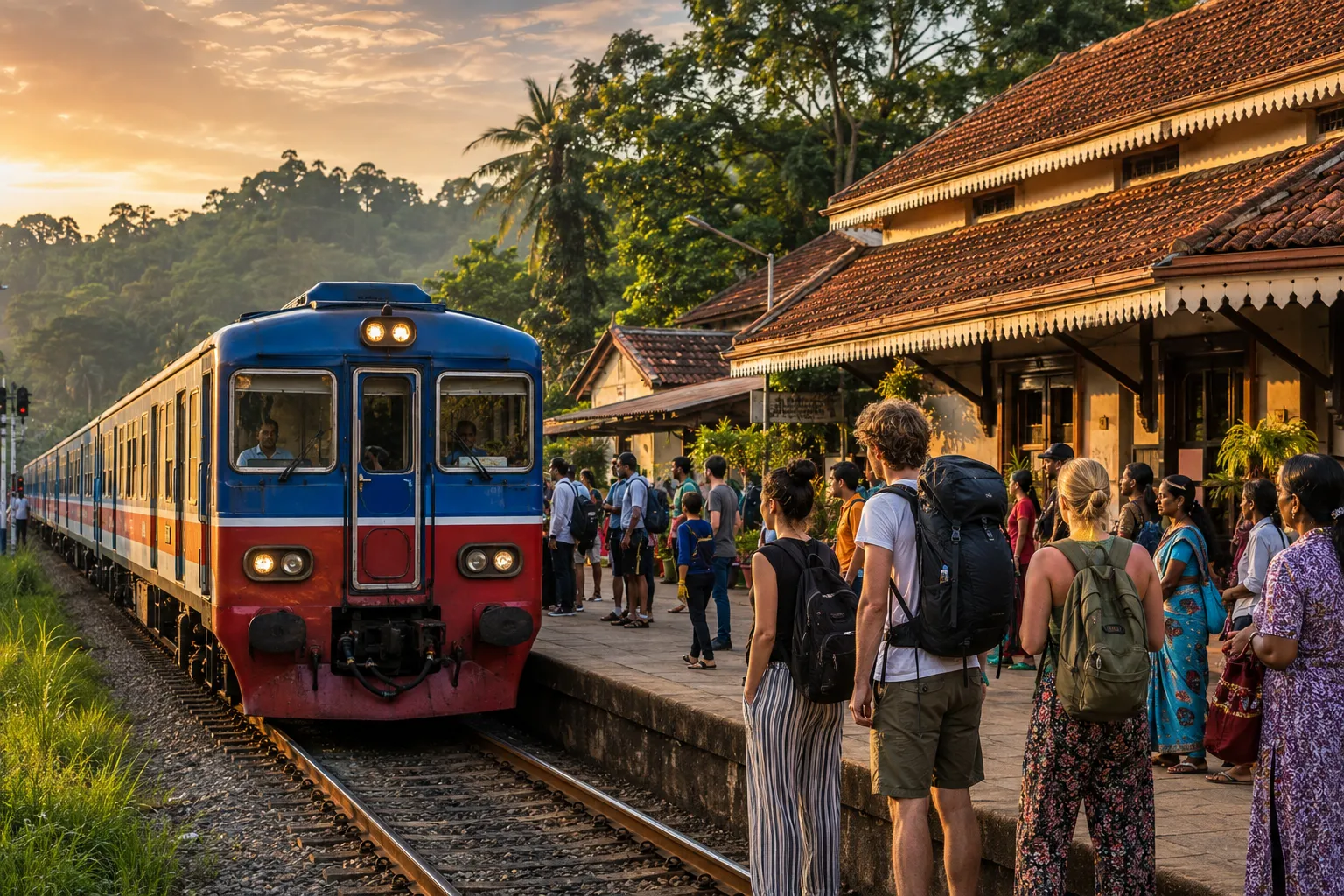
Sri Lanka offers four main transportation options: scenic trains (best for hill country routes), affordable buses (most extensive network), private drivers (most convenient for families), and domestic flights (fastest for long distances). Trains cost $1-8 per journey, buses under $3, private drivers $40-60 daily, and flights $80-150. Most tourists combine 2-3 methods depending on their route and budget.
• Trains are ideal for Colombo-Kandy and hill country routes with stunning scenery • Buses reach everywhere trains don’t go and cost under $3 for any journey • Private drivers eliminate logistics stress and cost $40-60 per day including fuel • Domestic flights save 6-8 hours on long routes like Colombo to Jaffna • Book train seats 30 days ahead during peak season (December-March) • Express buses are faster and more comfortable than local buses • Tuk-tuks work best for short city trips under 10km • International driving permits aren’t required for hiring drivers • Safety is good on all public transport with normal travel precautions • Combine methods for the best experience – trains for scenery, drivers for flexibility
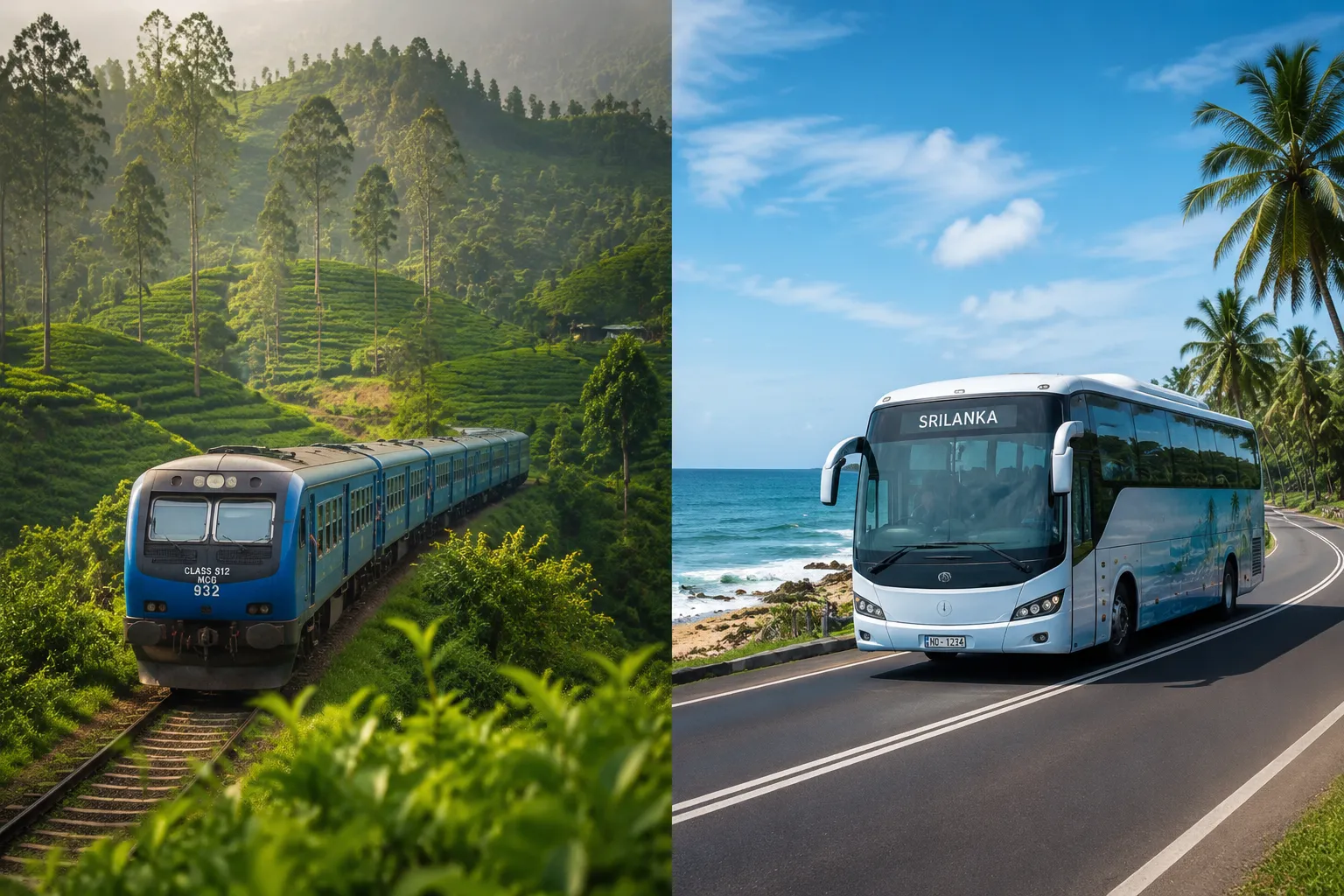
Private drivers offer the most convenience for first-time visitors, while trains provide the most memorable experiences for scenic routes.
For tourists visiting Sri Lanka for 7-14 days, the best approach combines two transportation methods. Use trains for the famous Colombo-Kandy-Ella route through tea country, then hire a private driver for coastal areas and cultural sites that trains don’t reach.
Choose a private driver if you:
• Travel with family or have mobility concerns
• Want flexibility to stop at viewpoints and local restaurants
• Prefer air conditioning and guaranteed seating
• Have limited time and want to maximize sightseeing
Choose trains for: • The scenic hill country route (Kandy to Ella) • Budget travel under $50 per day • Meeting locals and authentic cultural experiences • Iconic travel photography opportunities
Avoid renting a car yourself unless you’re an experienced driver in developing countries. Sri Lankan roads are narrow, traffic rules are loosely followed, and navigation can be challenging even with GPS.
Most successful itineraries use trains for 2-3 days in hill country, then switch to a private driver for the remaining time.
Train tickets cost $1-8 per journey depending on class, while buses cost under $3 for any distance across the country.
• Third Class: $1-2 (basic seats, crowded but authentic)
• Second Class: $2-4 (reserved seating, fans, more comfortable)
• First Class: $4-8 (air conditioning, wider seats, observation car access)
• Local buses: $0.50-2 (frequent stops, basic comfort) • Express buses: $1-3 (fewer stops, air conditioning, assigned seats) • Luxury coaches: $3-5 (premium comfort, onboard refreshments)
Sample route costs:
Hidden costs to consider: Trains require advance booking fees ($0.50) and potential tuk-tuk rides to/from stations ($2-5). Buses include more frequent meal stops that can add $5-10 daily.
For budget travelers, buses offer better value since they reach more destinations. For the iconic hill country experience, train first-class tickets are worth the premium.
Public transportation in Sri Lanka is generally safe for tourists with standard travel precautions about belongings and personal space.
Both trains and buses maintain good safety records. The main concerns are petty theft and overcrowding during peak hours, not violent crime or accidents.
Safety tips for trains:
• Keep valuables in a money belt or hidden pocket
• Choose second or first class for overnight journeys
• Sit near families or other tourists when possible
• Avoid hanging out of doors despite locals doing so
Safety tips for buses: • Use express buses for long distances (better maintained) • Keep bags on your lap or between your feet • Board early to avoid being pressed against doors • Choose window seats when available
Women travelers report feeling safe on both trains and buses, especially during daytime. Evening travel is fine on main routes but avoid very late departures (after 9 PM) on local buses.
Common sense precautions work: Don’t flash expensive electronics, keep copies of documents separate from originals, and trust your instincts about situations that feel uncomfortable.
The biggest risk is missing connections due to delays, not safety issues.
Most tourists should hire a driver rather than self-drive due to challenging road conditions, traffic patterns, and navigation complexity.
Self-driving in Sri Lanka requires significant experience with developing country road conditions. Traffic moves chaotically, road signs are inconsistent, and GPS often fails in rural areas.
Hire a driver if you: • Want to relax and enjoy scenery instead of focusing on driving • Travel with elderly family members or young children • Plan to visit multiple regions in limited time • Prefer having local knowledge about restaurants and attractions
Consider self-driving only if you: • Have extensive experience driving in India, Southeast Asia, or similar regions • Plan to stay in one area for several days • Are comfortable with aggressive traffic and unclear road markings • Want maximum flexibility for spontaneous stops
Driver costs: $40-60 per day including fuel for distances under 100km daily. Longer distances add $0.50-1 per extra kilometer.
Car rental costs: $25-40 per day plus fuel ($15-25 daily) plus insurance ($5-10 daily).
The cost difference is minimal, but drivers eliminate stress and provide valuable local insights about road conditions, shortcuts, and cultural sites.
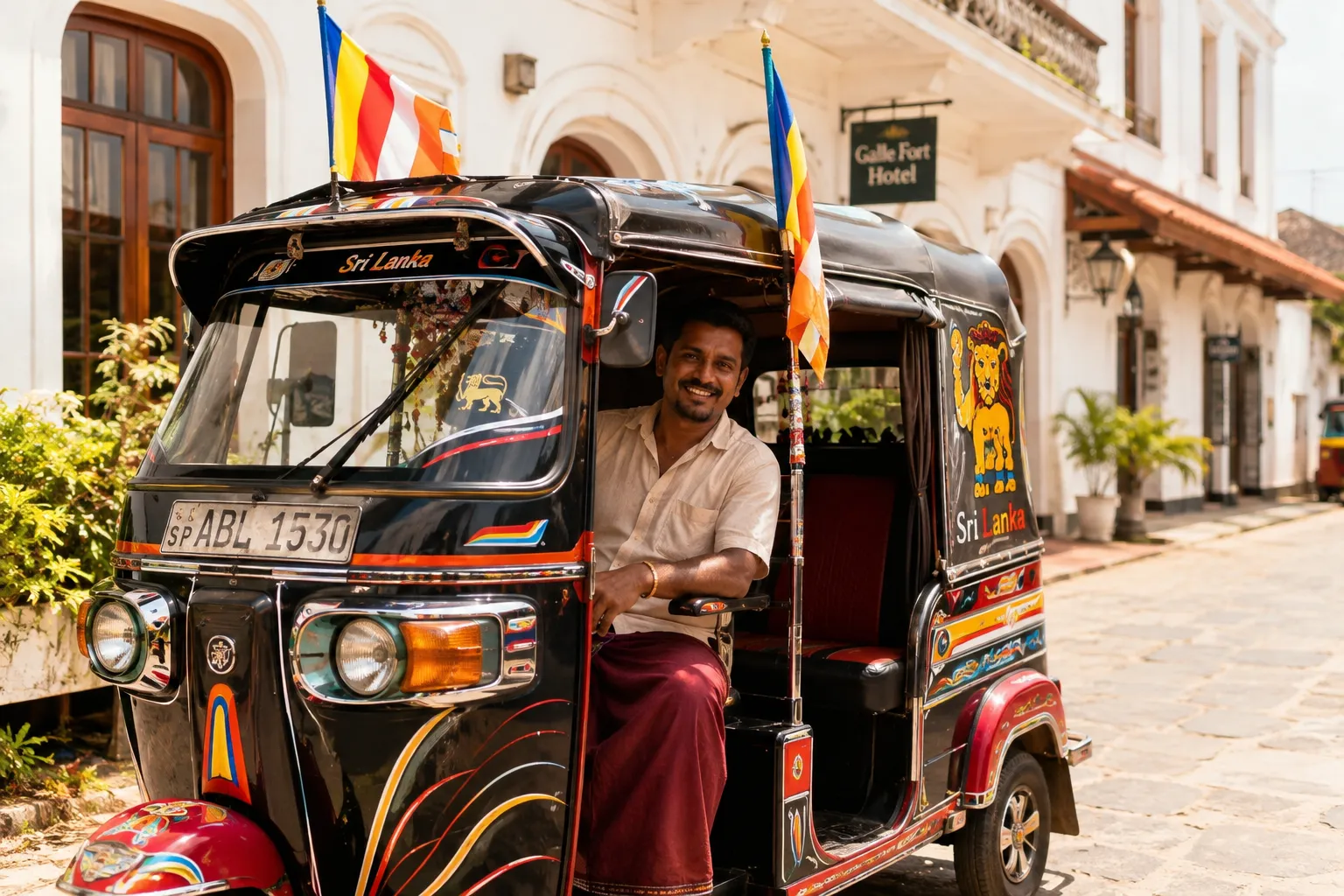
Express trains make fewer stops and complete journeys 30-60 minutes faster, while local trains stop at every station but offer more departure times.
• Skip smaller stations between major cities • Offer first-class observation cars on scenic routes • Run 1-2 times daily on popular routes • Require advance reservations for guaranteed seating • Cost $1-2 more than local trains
• Stop at every station (15-25 stops on major routes)
• Depart every 2-3 hours throughout the day
• Allow flexible travel without advance booking
• Often crowded with commuters and vendors
• Provide authentic local cultural experiences
Best express routes:
When to choose express: Limited time, traveling during peak tourist season (December-March), or wanting guaranteed seating with air conditioning.
When to choose local: Flexible schedule, budget under $30 daily, or wanting to interact with locals and experience authentic Sri Lankan train culture.
Both train types use the same scenic tracks, so views are identical. The main difference is comfort level and journey duration.
Domestic flights save 6-8 hours on long routes but cost 15-20 times more than trains, making them worthwhile only for travelers with very limited time.
Sri Lanka’s small size means most destinations are reachable by land in 3-8 hours. Flights only make sense for specific routes where ground transport takes a full day.
Flights worth considering:
• Colombo to Jaffna: 1 hour flight vs 8 hours by road
• Colombo to Trincomalee: 45 minutes vs 6 hours by road
• Colombo to Batticaloa: 1 hour vs 7 hours by road
Stick with ground transport for: • Colombo to Kandy: 3-4 hours by train/car • Colombo to Galle: 2-3 hours by train/car • Any hill country destinations (no airports nearby)
Flight costs: $80-150 one-way depending on route and season. Train/bus costs: $3-8 for the same routes.
Consider flights if you: • Have only 5-7 days total in Sri Lanka • Are over 65 and find long ground journeys tiring • Want to maximize time in specific regions like the north or east coast
Most tourists find ground transport more rewarding since the journey itself offers cultural experiences and scenic views that flights miss entirely.
Train reservations can be made 30 days ahead online or at stations, while most buses operate on a first-come, first-served basis without advance booking.
• Online: Sri Lanka Railways official website (limited routes available) • Station counters: All major stations sell advance tickets • Travel agencies: Hotels and tour operators can book for a small fee ($2-5) • Mobile apps: Third-party apps like 12Go offer some routes
Book trains 30 days ahead during peak season (December-March) for popular routes like Colombo-Kandy and Kandy-Ella. Off-season booking 3-7 days ahead usually works fine.
Most buses don’t accept advance reservations. You buy tickets when boarding or at the station 30 minutes before departure.
Exception: Luxury intercity coaches on routes like Colombo-Jaffna sometimes accept phone reservations through hotels.
Practical booking strategy:
Peak season warning: December 20 – January 10 sees heavy local holiday travel. Book trains immediately upon arrival or risk standing room only.
The biggest mistake is trying to cover too much ground too quickly, leading to exhausting travel days that waste precious vacation time.
Tourists often plan Colombo-Kandy-Ella-Galle-Yala in 7 days. This means 2-3 hours daily just moving between destinations.
Better approach: Choose 2-3 base locations and explore thoroughly rather than rushing between 5-6 places.
The famous Kandy-Ella train sells out weeks ahead during peak season. Tourists arrive expecting to buy tickets the same day.
Solution: Book this route within 24 hours of arriving in Sri Lanka, even if you’re not sure of exact dates.
Many tourists think buses are unsafe or uncomfortable and miss the most extensive transport network in the country.
Reality: Express buses are clean, air-conditioned, and reach destinations trains don’t serve.
Tourist-focused drivers often quote $80-100 daily when local rates are $40-60 including fuel.
Solution: Ask your accommodation to recommend drivers or negotiate directly with drivers at tourist sites.
Buses and tuk-tuks rarely have change for large notes (1000+ rupee bills).
Prevention: Keep 100-500 rupee notes for transport and 50-100 rupee notes for short tuk-tuk rides.
Yes, independent travel using trains and buses is straightforward for tourists comfortable with basic navigation and flexible scheduling.
Sri Lanka’s public transport system reaches virtually every tourist destination. English signage exists at major stations, and locals often speak enough English to provide directions.
Independent travel works well for: • Backpackers and budget travelers under 35 • Experienced travelers familiar with Asian public transport • Flexible itineraries that can adapt to delays or missed connections • Travelers who enjoy cultural interactions and authentic experiences
You’ll need basic skills: • Reading simple maps and understanding station names • Asking locals for directions (most are very helpful) • Handling minor delays and schedule changes • Carrying snacks and water for longer journeys
Routes easiest for independent travel:
Consider a driver for: • Remote areas like Yala National Park • Tight schedules with multiple stops per day • Traveling with elderly family members or young children • First-time visitors to South Asia
Many successful tourists use public transport for main routes, then hire drivers for 1-2 days to reach specific attractions like national parks or remote temples.
Trains run close to schedule on main routes but can face 30-60 minute delays during monsoon season, while buses are generally punctual but subject to traffic conditions.
On-time performance: 70-80% during dry season, 60-70% during monsoons (May-July, October-December).
Common delay causes:
• Heavy rainfall affecting tracks in hill country
• Mechanical issues with older locomotives
• Increased passenger boarding time at busy stations
• Occasional signal problems on single-track sections
Most reliable routes: Colombo-Kandy express trains and coastal lines to Galle.
Express buses maintain better schedules than local buses since they make fewer stops.
Factors affecting bus timing: • Traffic congestion in Colombo (add 1-2 hours during rush periods) • Road conditions during monsoon season • Festival days when roads become extremely crowded • Mechanical breakdowns (more common on older local buses)
Planning buffer time:
• Add 1 hour to train schedules for connecting transport
• Add 30 minutes to express bus schedules
• Avoid travel on full moon days (Poya holidays) when services reduce significantly
Backup options: Most routes have multiple daily departures, so missing one connection rarely strands travelers overnight.
Both systems work reliably enough for independent travel, but build flexibility into tight itineraries.
Local buses offer the lowest cost for long-distance travel at under $3 for any journey across the country, compared to $40-60 daily for private drivers.
Colombo to Jaffna (400km):
• Local bus: $2-3 (8-10 hours)
• Express bus: $3-4 (7-8 hours)
• Train: $3-6 (8-9 hours)
• Private driver: $80-120 (6-7 hours)
• Domestic flight: $100-150 (1 hour)
Money-saving strategies: • Use local buses for routes under 200km where comfort matters less • Book second-class train tickets instead of first-class (save $2-4 per journey) • Travel during off-peak hours to avoid rush-period surcharges • Bring your own snacks and water (saves $5-10 daily)
Hidden costs to consider: Local buses make frequent meal stops where you’ll spend $3-5 per meal. Express buses and trains allow you to bring food and control costs better.
Budget breakdown for 10-day transport:
• Ultra-budget (local buses only): $15-25 total
• Comfort budget (express buses + some trains): $25-40 total
• Mixed approach (trains + occasional driver): $60-100 total
For travelers on strict budgets under $30 daily, local buses provide access to the entire country. The trade-off is longer journey times and basic comfort levels.
The train journey takes 3-4 hours depending on service type, while buses take 3.5-5 hours depending on traffic and route.
• Express trains: 2.5-3 hours (2 daily departures)
• Intercity trains: 3-3.5 hours (3 daily departures)
• Local trains: 4-4.5 hours (6 daily departures)
Train departure times from Colombo: 5:55 AM, 8:30 AM, 10:35 AM, 3:35 PM, 6:00 PM, 8:30 PM
• Express buses: 3.5-4 hours (every 30 minutes) • Local buses: 4.5-5 hours (every 15 minutes) • Luxury coaches: 3-3.5 hours (4 daily departures)
Traffic impact on buses: Departing Colombo between 7-9 AM or 5-7 PM adds 1-2 hours due to urban traffic congestion.
Best timing for each option: • Fastest overall: Morning express train (5:55 AM arrival in Kandy 8:55 AM) • Most convenient: Mid-morning express bus (avoids rush hour) • Most scenic: Any train route (passes through mountains and tea plantations) • Most flexible: Local buses (frequent departures, no reservations needed)
Practical recommendation: Take the morning express train for speed and scenery, or use express buses for flexibility without advance booking requirements.
Both options cost $2-4 and offer comfortable seating. Trains provide better views, while buses offer more departure flexibility.
No, you don’t need any driving permit to hire a driver in Sri Lanka since you’re not driving yourself – only a valid passport for identification.
This is a common confusion among tourists who mix up hiring a driver with renting a car for self-driving.
For hiring a driver, you only need: • Valid passport (for hotel bookings and identification) • Cash or credit card for payment • Basic communication in English (most drivers speak conversational English)
If you wanted to rent and drive a car yourself, you would need:
• International Driving Permit (IDP) from your home country
• Valid home country driver’s license
• Credit card for security deposit
• Minimum age 21-25 depending on rental company
Driver hiring process:
What’s included in driver rates: • Driver’s meals and accommodation (for multi-day trips) • Fuel for agreed daily distance (usually 100-150km) • Basic vehicle insurance • Driver’s local knowledge and route planning
Extra charges typically apply for: • Distances over 150km per day ($0.50-1 per extra km) • Airport pickups ($10-15 from Colombo airport) • Very early departures before 6 AM • Waiting time over 2 hours at attractions
Most tourists find hiring a driver simpler and safer than self-driving, especially for first visits to Sri Lanka.
Trains offer the most scenic route through tea plantations, while private drivers provide flexibility to stop at specific estates and viewpoints that trains pass by.
The hill country region (Kandy-Nuwara Eliya-Ella) is Sri Lanka’s most famous scenic area, and transportation choice significantly impacts your experience.
Best train routes for tea plantation views: • Kandy to Nuwara Eliya: 4-5 hours through continuous tea estates • Nuwara Eliya to Ella: 3-4 hours with the most dramatic mountain scenery • Haputale to Ella: 1-2 hours through the heart of tea country
Advantages of train travel: • Panoramic windows in first-class observation cars • Ability to hang out of doorways for photography (though not officially recommended) • Authentic experience riding with tea plantation workers • Cost under $5 for the entire hill country route
Advantages of private drivers: • Stop at specific tea factories for tours and tastings • Visit viewpoints like World’s End in Horton Plains National Park • Flexible timing for sunrise/sunset photography • Access to boutique tea estates off the railway line
Optimal combination approach: Take the train from Kandy to Ella for the scenic experience, then hire a driver for 1-2 days to visit specific plantations, waterfalls, and hiking trails that require road access.
Tea plantation visits requiring road transport: • Pedro Tea Estate (near Nuwara Eliya) • Lipton’s Seat viewpoint (near Haputale) • Dambatenne Tea Factory (near Ella) • Blue Field Tea Gardens (near Ramboda)
Timing considerations: Morning trains offer the clearest mountain views before afternoon clouds roll in. Plan tea factory visits between 9 AM – 4 PM when operations are active.
The hill country rewards travelers who combine both transportation methods rather than limiting themselves to just trains or just drivers.
How far in advance should I book train tickets in Sri Lanka? Book scenic routes like Kandy-Ella 30 days ahead during peak season (December-March) and 3-7 days ahead during off-season. Popular routes sell out quickly during holidays.
Can I pay for buses and trains with credit cards? No, both buses and trains require cash payment in Sri Lankan rupees. Bring small bills (100-500 rupee notes) as drivers rarely have change for large denominations.
Are there bathrooms on long-distance buses and trains? Express trains have basic toilets, but local trains and most buses do not. Plan bathroom breaks during meal stops every 2-3 hours on long journeys.
What’s the best app for navigation and transport schedules? Google Maps works well for bus routes and general directions. For train schedules, check at stations since online information is often outdated. Download offline maps before traveling.
How much should I tip drivers and transport staff? Tip private drivers 500-1000 rupees ($2-4) per day for good service. No tipping expected on buses or trains, but small tips (100-200 rupees) are appreciated for helpful conductors.
Can I bring large luggage on trains and buses? Yes, but space is limited. Trains have overhead racks and floor space near doors. Buses store large bags in compartments underneath. Keep valuables in carry-on bags.
What happens if I miss my train connection? Most routes have multiple daily departures. Buy tickets for the next available train at the station. During peak season, you might need to wait several hours or take a bus instead.
Are there women-only sections on public transport? Some buses have women-only seats at the front, but this isn’t consistently enforced. Trains don’t have designated women’s sections, but solo female travelers report feeling safe in second and first class.
How early should I arrive at stations? Arrive 30 minutes early for trains to find your car and seat. For buses, arrive 15 minutes early to ensure seating, especially during morning and evening rush hours.
What’s the latest safe time to travel by bus or train? Trains run safely until 9-10 PM on main routes. For buses, stick to express services and avoid local buses after 8 PM in rural areas. Major city routes run safely later.
Can I eat food from vendors on trains? Yes, train vendors sell fresh snacks and meals that are generally safe. Look for hot, freshly prepared items and avoid anything that’s been sitting out. Bottled water is always available.
What should I do if transportation strikes occur? Strikes (hartals) occasionally shut down public transport. Hotels usually provide advance warning. Keep backup cash for emergency tuk-tuks or wait until strikes end (usually 24 hours).
Getting around Sri Lanka successfully means matching your transportation choice to your specific route, budget, and travel style. Use trains for the unforgettable hill country scenery, buses for budget-friendly access to every corner of the country, and private drivers when you want flexibility and comfort.
Start by booking the iconic Kandy-Ella train route as soon as you arrive, since this sells out quickly during peak season. Then use express buses or drivers for other destinations based on your budget and time constraints.
Most importantly, build flexibility into your schedule. Sri Lankan transport runs reliably enough for independent travel, but delays happen. The journey itself becomes part of the adventure when you’re not rushing to stick to an overly ambitious itinerary.
Next steps: Download offline maps, exchange money for small rupee bills, and ask your first accommodation to recommend reliable drivers for routes where you want door-to-door service. The combination of scenic trains and practical buses or drivers gives you the best of both worlds – memorable experiences and efficient travel.
SEO Meta Title: Sri Lanka Transportation Guide: Trains, Buses, Drivers & Flights